

You’ve likely already browsed through various SEO guides on your journey to this article. That means you’ve probably heard things like:
- Invest heavily into dozens of expensive tools that will automate your SEO strategy.
- Follow every single algorithm update and use it to pivot regularly.
- Use AI to track every core metric and make regular changes to your strategy.
All of this information might be great if you have a lot of money and expertise to throw at the problem, but as a startup, it just leads to analysis paralysis. You’ll spend more time creating plans over actually getting started.
That’s why I’ve put together this guide to explain how to approach SEO as a startup. I’ll explain what you need to do to gain traction at the early stages, and how to do it without spending your entire budget. Everything here is backed by my decade of experience in this industry and the countless startups I’ve helped grow online.
How Startup SEO Works As a Growth Lever
Startups need growth. Whether you blow up overnight or gain steady traction across several months, being able to convert customers organically will ultimately decide whether you succeed or fail online.
Before I show you exactly how you can build out your SEO strategy as an SEO startup, I want to touch on why SEO matters in the first place.
1. Increases organic traffic
90% of all clicks go to the first page of Google. This means, if you aren’t appearing near the top of the SERPs, you usually aren’t getting seen.
By focusing on high-quality content and targeting the right keywords and optimizing, SEO helps you climb those rankings. That means more people visit your site, more people see the value your brand offers, and ultimately, more people buy your products.
That equals profit, and you don’t even have to pay per click.
2. It leads to a higher click-through rate (CTR)
The click-through rate for the number one ranking result on all SERPs is around 39.8%, compared to 18.7% for the second highest result.

What does this mean? Essentially, if you had 100 people searching for something, around 40 of them will click on the very first result. This value is dropping even lower now that AI overviews are in play - resulting in around 34.5% fewer clicks, as per Ahrefs.
In short, it isn’t getting any easier to get found online. If you want to reach the top spot and get people visiting your site organically, you need SEO.
3. It compounds value over time
The next point I want to make is that SEO compounds over time. It isn’t like a PPC ad where you get hundreds of customers in a short-term burst but then struggle to maintain momentum.
Every blog post and keyword tweak you make builds traction. Your authority grows a little bit, your rankings improve, your traffic snowballs. It can be hard to see at first, but over time, momentum snowballs, all without pumping your profit into ads each month.
4. SEO is a must in the AI era
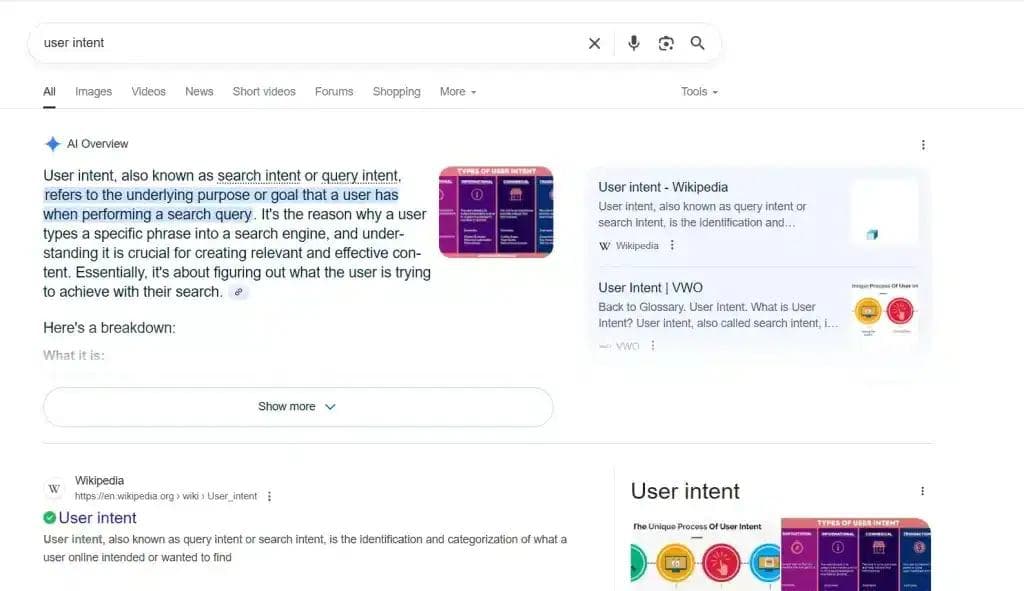
Nowadays, large language models (LLMs) like ChatGPT and AI overviews on Google dominate global search, pulling information from the web and presenting it to users directly. For instance, if I search ‘how much food does my dog need per day?’, take a look at the page:

What does this mean? Essentially, businesses aren’t just fighting against their competitors anymore. They’re also battling against AI for visibility.
However, there’s an opportunity here. You’ll also notice that the AI Overview cites its sources.

If you can position your content in a way that answers questions clearly, demonstrates authority and is well-suited to easy extraction, you increase the chances of being featured in AI-generated summaries, positioning you as a trusted source on the front page of Google.
The problem? If you aren’t optimizing your site and content, you’re invisible to these systems, and your website won’t surface in the knowledge sources these models rely on. SEO will help you understand which sources LLMs are drawing from and how to position your content so it’s included in those results.
This makes SEO not just a channel for ranking in Google, but also the key to ensuring your brand has a voice in a search landscape increasingly reliant on AI.
First Things First: Is SEO Right For Your Business?
There’s no use starting with SEO before you determine if it’s right for your startup.
Some businesses find that their customers aren’t using Google to search for specific solutions. Maybe they prefer to use LinkedIn or shop in-store. In this case, you may need to reconsider your online strategy and look at whether more targeted, offline outreach might work better.
You may have heard that SEO is a way to get free traffic. And while it is a strong growth lever, it’s better suited as a long-term strategy, not a quick fix. You need to dedicate a lot of time, along with a good amount of resources, especially at the early stages. If you want an instant solution and have significant cash to invest, paid ads may be a better choice.
Still not sure whether SEO is right for your startup? There are two methods I’d recommend to see if there’s a good opportunity for your business.
Scope out your competitors
Your competitors aren’t the enemy, even though it may seem like that at times. They can actually tell you a lot about the business you’re in and what your target audience is seeking.
By identifying who your direct competitors are, you can see which keywords they rank for and the type of content they’re creating to drive traffic. This information is key for shaping your own SEO strategy.
My recommendation: Despite what you may see online, you don’t need any fancy tools to conduct your competitor analysis. Just search for similar products and services in your area online and click onto the brands that appear at the top of the list.
Analyze their website, socials, and any other means they use to connect with their target audience. If your competitors are building engagement through blogs, articles and social media posts, you should be too. This process will also provide guidance on the types of content you should be creating.
For instance, if I’m running a SaaS business and type “project management platform” into Google, I can see that Trello by Atlassian appears as one of my primary direct competitors.

From the brand’s homepage, I can see that Trello offers guides to help set up the platform, remote working guides, and educational webinars, as well as a link to the Trello blog.

The blog contains everything from product feature guides to project management tips, employee onboarding checklists and other business-focused advice.

Already, you can see that SEO is a viable strategy for Trello, and get insights into the kinds of content and ideas they use to drive sales. As a close competitor, this can give you a massive headstart.
Check online market demand
One thing I always recommend is checking the online market demand for your product or service. As I mentioned earlier, some businesses might not have that much of a market demand, which means there won’t be a high search volume for their products or services.
My top recommended free tools to help with this include:
Assess different search terms relevant to your business to see how many people are searching for those terms over time. Here are two examples - one of a high interest topic and one of a low interest topic.
Example of high interest:

Example of low interest:

If interest is low in your niche, you can probably keep your SEO strategy to a minimum, but if search volume is high and stable, it’s worth diving deeper into SEO for your startup.
My recommendation: It’s important to be specific with your keywords when you search. Say you’re running a speciality local bakery in Los Angeles. The keyword “desserts” will have a high search volume, but it doesn’t indicate demand for your business, niche, or area. Instead, you could try searching for “gluten free desserts LA”. It’s more specific, and shows customers in your area are looking for specialty products like yours.
Getting Started with SEO: The Basics
Every SEO strategy needs a solid foundation. Without this, you’ll waste time creating content that attracts the wrong traffic. Get these basics right, and you’ll:
- Write content that matches what search engines want to show
- Write content that aligns with what your audience actually wants to see.
- Attract qualified leads who are ready to buy, not just casual browsers.
- Build a content plan that supports every stage of your sales funnel from day one.
Here are the two foundational steps I recommend:
Technical Foundation
It’s a good idea to focus on your technical foundation before you start working on any other aspect of your website. This means:
- Fixing any broken links and redirecting any that are 404ing.
- Improving website speed through the right image format and compressing images, and browser caching.
- Creating an XML sitemap that lists all the URLs you want search engines to crawl.
- Optimizing for mobile, tablet, and desktop to make sure your website design is as responsive as possible.
This will improve the crawlability and indexing of your website, leading to better search engine performance. Users will find your pages easier to navigate too, no matter which platform they’re using.
Know Your Audience
The first step to creating great content is knowing your audience. This will make sure that your keywords are focused, and your tone and messaging will actually resonate.
A good place to start is by creating customer personas based on what you know about your audience. These personas should outline various demographics by:
- Age range
- Location
- Education level
- Motivations
- Pain points
- Preferred content channels
There are multiple ways to identify your different customers, so feel free to amend my list to your liking.
Remember: you can have more than one persona depending on your audience and platform. Create one that showcases your Instagram followers and another to highlight who’s more likely to be viewing your YouTube videos. That way you can tailor every aspect of your content to different segments.
Look at which device your customers are using to consume your content as well, as this will allow you to optimize for mobile, desktop, or tablet.
If you’re looking for a free template, some of my favourites include:
Here’s an example of the Semrush template:

Understand The Intent Behind Your Audience’s Searches
Search intent is the “why” behind every query. If you can map your content strategy to the right intent, Google will reward you with better rankings because you’re giving searchers exactly what they want.
First off, take what you know about your audience and business and brainstorm some seed topics based on your business. Think of the things you sell, the problems you solve and questions your customers will ask. Then, Google these topics and look at the top search results. Notice what type of content shows up - are you looking at blog posts, product pages, videos?
From there, match what you see into one of the four buckets below.
Informational
When the searcher is looking to learn something about a specific topic or find an answer to their question. Informational queries usually start with “how”, “why”, “what”, “where” or “when”, resulting in blogs, recipes, explanations, and guides that provide the required information.
Example searches include: how to bake cookies, why does my phone keep crashing, what is organic traffic.

Navigational
When a user wants to go straight to a specific site, with a certain activity in mind, such as accessing their email account or upgrading their mobile phone.
Example searches include: Gmail, iCloud, LinkedIn login

Commercial Investigation
When searchers are going through their research phase to help narrow down products and services. Comparison articles and buying guides usually rank highly for this search intent.
Example searches include: iPhone vs android, best laptop of 2025, photoshop reviews

Transactional
Users are looking for products to buy and are ready to make a purchase. Subscription pages, category pages, and product pages all perform best for transactional search.
Example searches include: hire a plumber near me, Amazon subscription, order flowers online.

This process will make your later keyword research laser focused. Rather than collecting random terms, you’ll:
- Which content formats Google expects for each topic.
- How to target information keywords strategically to build authority over time.
- Where to prioritize commercial terms for quick wins.
Startup SEO: A Step-by-Step Guide
Now that you know your audience and you’ve mapped out search intent, it’s time to turn that groundwork into an actionable SEO plan. Follow these steps to get started.
1. Keyword Research
Keyword research is where you turn your understanding of intent into a practical roadmap. Instead of trying to rank for everything, focus on keywords that match your audience’s goals as well as your startup’s growth stage.
The best place to start is to take your topics from your intent mapping and plug them into free tools. Here are my top two platforms that can help.
This is a completely free platform with limited functionality. It lets you look at keyword interest over time and compare it with other keywords. You can filter by the type of search such as image search, news, YouTube etc. and see what’s trending now.
For instance, here’s my search for ‘how to write a book’.

You can track interest over time to see if your keywords have enough interest to provide an opportunity for your business. Handily, you can also see related topics and queries to narrow down further topic and subtopic possibilities:

The problem with Google Trends is that it doesn’t give exact search volumes, so it isn’t comprehensive enough to build out your entire strategy. It’s best used as a navigational tool to spot trending topics and validate that your keywords are gaining traction.
ManGools provides keyword research, local SERPs analysis, backlink analysis, as well as SEO insights. It offers free options and paid subscriptions to fit around the budget requirements of your startup.
ManGools is far more comprehensive than Google Trends. Here’s what happens when I enter the same ‘how to write a book’ keyword into the platform.

First off, you’ll notice that ManGools provides an accurate monthly search volume, along with a keyword difficulty. This indicates how hard the phrase will be to rank for based on the level of competition.
In addition, ManGools will display related key terms along with search volumes and keyword difficulties to help you find additional topics and subtopics to target.

Don’t worry about targeting every keyword that pops up. Take your list of seed keywords and input them into this platform to identify the low-hanging fruit. These are the key terms that are easy to rank for because they have low levels of competition and keyword difficulty, along with a moderate to high search volume. As long as the keyword is relevant, go for it.
Next, look for content gaps, where your competitors are ranking but you’re not. This will act as a good starting point for your content strategy and allow you to capture your audience through a new avenue, increasing organic traffic.
I’d recommend creating a keyword list, identifying the following:
- Primary keywords
- These are the keywords with the highest priority.
- Secondary keywords
- Find these in your related keywords, including long-tail terms.
This will result in a basic keyword map that showcases the different areas you can focus on with your content, along with keywords to target for each topic. Here’s an example of what you might have at this stage:

2. Identify Topic Clusters
Topic clusters are a way of grouping together related pages and content based on a central topic or theme. This means, instead of having lots of standalone pages and ideas, your content is linked, making it easier to build in-depth authority over a niche.
Each topic cluster starts with a pillar page, which is the main hub for that central topic or theme. From that pillar page, you’ll then create supporting content made up of individual pages that focus on a more niche sub-topic. This “cluster content” then feeds back traffic to your main page, creating a web of authority over a specific topic.
For example, if you’re running a stationery website you might create a pillar page dedicated to all “office supplies” and then create content for more specific pages, such as “the best ballpoint pens” and a comparison guide of the top desk organizers. You would then link those separate pages back to the pillar page, creating a topic cluster around office supplies.
To show how this looks in practice, here’s an example of clustering on the topics of AI, e-learning, and video game localization.

As you can see, ‘what is AI translation’ is the main topic cluster. We then branch out into different subtopics such as ‘how AI translation works’, ‘AI vs human translation’ and ‘applications of AI translation’. All of these topics expand and feed back into the main subject, building a network of authoritative articles on one key area.
Why does this matter? Aside from showing your audience your expertise in a specific area, having topic clusters in place makes your site easier to crawl and shows search engines like Google that you know your specialization well. This equals a higher SERP ranking with time and more organic traffic.
Top tip: Your keyword research should guide your topic clusters. You should build your pillar pages and supporting sub-topics around high-volume keywords, improving your rankings and increasing organic traffic.
3. Develop a Content Strategy That Actually Drives Signups
Got your keywords and topic clusters ready? It’s time to start developing your content strategy. To help, I’ve divided this section up into different phases, that way you can carefully build out your content strategy without missing a beat.
Phase One: Bringing Existing Content Up to Scratch
If you have existing content, optimize it first. This is a quick and easy way to get some practice in, but it’s also important that all your content is of the same quality.
If you already have a lot of content, split it up and take it one page at a time and follow this basic checklist.
- Check that all pages have a meta title (under 60 characters)
- Check that all pages have a meta description (under 155 characters)
- Ensure all images have an alt text.
- Make sure pages internal link to other relevant pages on your site.
- Check page speed to see if large images or scripts are slowing performance.
- Look for opportunities to inject relevant keywords from your research into the content.
After this, analyse content structure. All of your articles need to follow a clear H1, H2, H3, and H4 structure, with each level guiding the reader and search engines through your content:
- H1 is your main title. You should only use one per page, and it should clearly state the topic of the article.
- H2s are for your main section headings. They break the content into big chunks and make it easier for readers (and search engines to scan). If your article is about ‘SEO basics’, H2s might include Keyword Research and Link Building.
- H3s sit underneath H2s and allow you to break sections down into smaller parts. For instance, under the Keyword Research H2, you may have H3s for Finding Keywords, Analyzing Search Intent and Recommended Tools.
- H4s (and beyond) are useful for drilling even deeper into topics if the section is complex, but try to limit their use as much as possible as they can make articles confusing.
Another good tip is to look for ways to incorporate additional lists, tables, images and videos within your content to break up long walls of text. This makes your articles easier to scan and your writing more engaging.
Even if the changes are only small, optimizing your existing content is an easy win and good place to start for your content strategy.
Phase Two: Creating Top of Funnel Content
FYI, this is where the marketing lingo comes in. (Sorry!) But it is important to know.
The marketing funnel is a model that describes the customer journey from the top all the way to the bottom. You may have already seen it. For reference, it looks like an upside down triangle.
When approaching your content strategy, it’s easier to start from the top of the funnel, which is when you capture people who are new to your brand and are looking to learn more or want a solution to a problem.
This is where your informational content comes into play. With your keyword research and topic clusters at the ready, outline a list of blog titles and user guides you could publish to create awareness of your brand while offering answers to your customer’s most searched for questions.
Top content types:
- Blogs
- Guides
- Articles
- Videos
Phase Three: Creating Middle of Funnel Content
The middle of the funnel is when commercial investigation is taking place. You want to offer guidance to help your customers narrow down their options. Try targeting more specific keywords that allow you to showcase your products or services, remembering that comparison articles often rank highest for middle of the funnel keywords.
Everybody loves a good success story, so highlight these too. That way, you get to demonstrate the value of your offering. I’d recommend brainstorming topics for landing pages and reaching out to previous customers to generate case studies. Not everyone will want to participate, but there’s no harm in offering an incentive to sweeten the deal.
Top content types:
- Comparison articles
- Case studies
- Landing pages
- Product demos
- Whitepapers
Phase Four: Creating Bottom of Funnel Content
This phase is all about driving signups and sales. It will come as no surprise to discover this is where your transactional content comes into play. Essentially, you’re looking to convert your leads into paying customers.
Content should be direct and make buying your product or service as simple as possible. Remember to tag CTA words such as “buy” and “shop” onto your relevant keywords. Trust me, it works.
Top content types:
- Category pages
- Product pages
- FAQs
- Price pages
Phase Five: Outreach
Finally, let’s talk about generating long-term growth - which is ultimately the end game with any SEO strategy. This includes creating evergreen content that will still be relevant in a year’s time, as well as adding guest posts and working with similar brands to secure relevant bank-links. It’s a surefire way to add more authority to your website.
4. Ongoing Monitoring
There’s no point putting all this effort into your SEO strategy if you aren’t keeping track of key metrics. This will help you understand what type of content works and which keywords you’re ranking highest for, so you can adjust your strategy as you grow.
Like I said earlier, you don’t want to be tied down to tracking every bit of information day in and day out. Instead, keep things simple.
Here’s what I’d recommend you track as part of your ongoing monitoring:
- Keyword rankings
- Total traffic
- Organic traffic
- New vs returning visitors
- Click-through rate (CTR)
- Bounce rate
- Session duration
- Conversion rate
- Core web vitals
Minimum Viable SEO Stack for Startups
Your startup might not have all the resources or funds in place for a complete SEO strategy, and let’s face it, which startup does? But there are some elements that are essential as a bare minimum. Here’s what I’d suggest looking into.
Essential SEO Tools
These are the most basic tools required to help in your SEO journey. Again, we’re focusing on free and affordable solutions, so even though tools such as Semrush and GA4 are ideal, they might not be the best for a business just starting out.
With this in mind, here’s what I’d recommend:
- Google Analytics 4 (GA4) for tracking user behavior and engagement across your site.
- Google Search Console for monitoring website performance data, backlinks and more.
- Screaming Frog for assessing technical issues including broken URLs.
- Google Keyword Planner for free keyword research.
Each listed tool offers something unique in the way of helping you develop the best SEO strategy while ensuring your website is always performing its best.
Keyword Research
Even the most basic SEO strategy requires keyword research. It will help to direct much of your content creation and allow you to rank better on search engines.
Free tools like ManGools, Semrush’s Keyword Search Volume Checker, AnswerThePublic, and Google Trends offer everything a startup could need to help with this.
Content Creation
By creating varied content based on your keyword research, you’ll not only rank better on Google and Bing etc., but you’ll also capture customers at different stages in their purchasing journey.
You should set up:
- Blogs
- User guides
- Case studies
- Landing pages
- Product pages
- Videos
Remember: target those at the top, middle, and bottom of the funnel.
And to help make sure your content is always optimized and easy to read, follow my writing guidelines.
Link Building
Link building is an easy win for any startup looking for growth through SEO. Scratching your head? You’re not alone. But it’s not as complex as you might think.
To clear things up, here’s an explanation of the two main types of links you’ll use in your content:
- Internal links
When you link to other pages within your site. For example, having a landing page that links to a product page.
- External links
When you link to pages outside your site. For example, having a blog that links to an external site to cite your sources.
External linking is a big part of link building. If you get other websites to link back to your own site, you improve your credibility and authority, meaning you’re more likely to rank higher in search engines.
Other websites could naturally choose to use your site for research and link back to your content that way. And what a win that would be! But usually some outreach is required for effective link building.
Pitch ideas to platforms that already have high authority within your area and get into the habit of guest posting where possible.
Early Metrics & KPIs
Finally, at a bare minimum, you should be tracking the following metrics:
- Traffic to your site
- Keyword rankings
- Conversion rate
- CTR
- Bounce rate
GA4 is the best tool to help with this but if you’re looking for a cheaper or free alternative, Google Search Console will help with many of these metrics, just remember there are more limitations.
That being said, you don’t want to start out drowning in numbers and KPIs, so take it slow at first and build your analytics from there.
Scaling SEO With Limited Resources
Chances are if you’re just starting out, resources are going to be few and far between. With this in mind, here are some tricks I’ve learned over the years, which could help with scaling your SEO.
Repurpose Your Existing Content
You should consider distributing your existing content beyond Google. Why? Well, it’s a quick and easy win, but it's also an effective way to drive more traffic to your site. This means repurposing your SEO content for:
- Twitter/X
- YouTube
- Product Hunt
You don’t have to use every platform listed - don’t overwhelm yourself. But one or two should help to improve your reach.
The key here is that you use fewer resources and less time by taking one existing blog and using it to generate multiple avenues for growth.
Top tip: other platforms play by different rules when it comes to content. Keep captions short and engaging while keeping posts on-topic. Twitter/X is known for its short character limit, which is currently set at 280, while LinkedIn’s algorithm prefers lengthy posts with a greater level of insights. YouTube and TikTok are optimized for video content and Instagram and Pinterest are image focused.
Use Your Products/Services as SEO Content
Have a limited content budget? Use your existing product/service content as a driver for SEO growth. Here’s how:
- Pull out product features and benefits as part of a detailed buying guide.
- Pit your top products against one another in a comparison article.
- Reach out to past customers and create case studies.
This is another way to repurpose content, taking less time out of your day and requiring fewer resources than an entirely new content strategy would.
Outsource Your Content Writing
If you don’t have the time or the resources but are willing to spend some money, you should consider outsourcing your content writing.
There are tons of affordable SEO tools available online, including free options such as Google Search Console and Google Trends, that give you access to insights and data in an instant. Leverage AI tools to help with organizing your ideas and developing a content strategy or creating outlines for blogs and landing pages etc.
Freelancer marketplaces and agencies can then help with writing the content, with many offering affordable quotes and packages without scrimping on the quality.
My Startup SEO Checklist
To help you get started with your SEO strategy, here’s my checklist, covering all the essential steps you should take as a startup trying to increase your reach.
Start with the basics
- Define 1-2 SEO goals (“rank in the top 10 for 3 key buying-intent keywords in 6 months”)
- Pick your minimum viable SEO tech stack
- Google Search Console for performance insights
- Google Keyword Planner or Ubersuggest for keyword research
- Screaming Frog for site audits
- Lay down the technical foundation for your site by:
- Fixing broken links and 404 errors
- Optimizing site speed (image compression, caching)
- Making sure your site functions well on mobile/tablet
- Creating and submitting an XML sitemap.
- Checking core web vitals like loading speed and visual stability.
- Do a competitor sweep - Google your core service/product keywords, visit the top ranking sites, note their content formats, topics and authority level.
- Conduct keyword research and competitor analysis
Keyword research
- Use free tools like Google Trends, Ubersuggest and Mangools to find keyword ideas.
- Identify 10 low competition, high relevance keywords to target first.
- Find content gaps by comparing competitor keywords with your own
- Create a keyword list with primary and secondary keywords.
Topic clusters
- Choose 3-5 pillar topics based on high priority keywords
- Create a pillar page for each topic
- Plan supporting content around sub topics, linking it back to the pillar page
Creating content
- Audit your existing content for on-page SEO
- Create content for each stage of the buyer journey to guide users down your sales funnel.
- Lay out a strategy for outreach and link building.
Monitoring and analytics
- Track key metrics with GA4 and Google Search Console, such as:
- Keyword rankings
- Total and organic traffic
- CTR and bounce rate
- Session duration
- Conversion rate
How SEO builds success over time
I was recently asked to help the startup OddsJam, a US-based sports betting company with minimal online presence at the time. They tasked me with increasing their organic traffic and building authority for their website.
Through in-depth keyword research I produced a detailed sitemap, keyword clustering document, a full technical SEO audit, fixed over 50 technical issues, created a comprehensive content strategy, and built high quality backlinks.
Within 10 months I had taken OddsJam from zero to 100,000+ organic visitors per month and had them ranking in the top 10 for hundreds of keywords. This not only indicates how powerful good SEO can be when it comes to growth, but also demonstrates the many different tactics that weave together in order to create a complete strategy.
Achieve Long-Term Growth for Your Startup With an SEO Expert
With the right amount of time and dedicated resources, SEO can really help to increase traffic and expand your reach. All you need are the right tools on your side and a detailed checklist to guide through the different stages of development for your own strategy.
Remember that SEO isn’t about quick wins. It’s about creating steady growth through careful keyword research, content optimization, competitor analysis, and ongoing monitoring. By following my step-by-step guide, you should be on your way to creating quality content that generates positive ROI.
While SEO works as a powerful growth-lever, it’s not always as easy as it seems. To simplify the process or for some further advice, book an SEO consultation with me. The first session is completely free, so you don’t have to worry about budget constraints, and I can help with everything from technical SEO to full SEO audits, depending on your requirements.
My service is 100% tailored to you, with an average seven-day turnaround for a six-month strategy. I’ve already supported over 90 different businesses with developing their online presence and I’d be happy to help you with yours.
Book a free consultancy today to find out just how SEO can work as an effective growth level for your startup.